
Commercial Coffee Maker Repair: Keeping Batch Brewers and Urns Running
Commercial drip coffee brewers and urns are workhorses in offices, convenience stores, hotel breakfast buffets, and cafés. While mechanically simpler than espresso machines, their high volume and continuous duty cycle create their own maintenance demands. Understanding commercial coffee maker repair helps operators keep batch coffee flowing and avoid the sour, weak, or burnt-tasting coffee that results from a neglected brewer.
Sprayhead Maintenance: The sprayhead distributes water in a pattern designed to saturate the entire coffee bed evenly. Mineral deposits and coffee oils gradually block the tiny orifices, concentrating water in the center and leaving the edges dry. Remove and soak the sprayhead in descaling solution weekly, and clear each orifice with a fine wire. Inspect the sprayhead plate for warping or corrosion and replace it if the spray pattern is visibly uneven.
Temperature Calibration: Brew water must remain between 195 and 205 degrees Fahrenheit for optimal extraction. If your coffee tastes sour or weak, the brew temperature may be too low; if it tastes harsh or burnt, the temperature may be running too high. A technician verifies actual water temperature at the sprayhead with a calibrated thermometer and adjusts the control board setpoint or replaces a drifting thermostat.
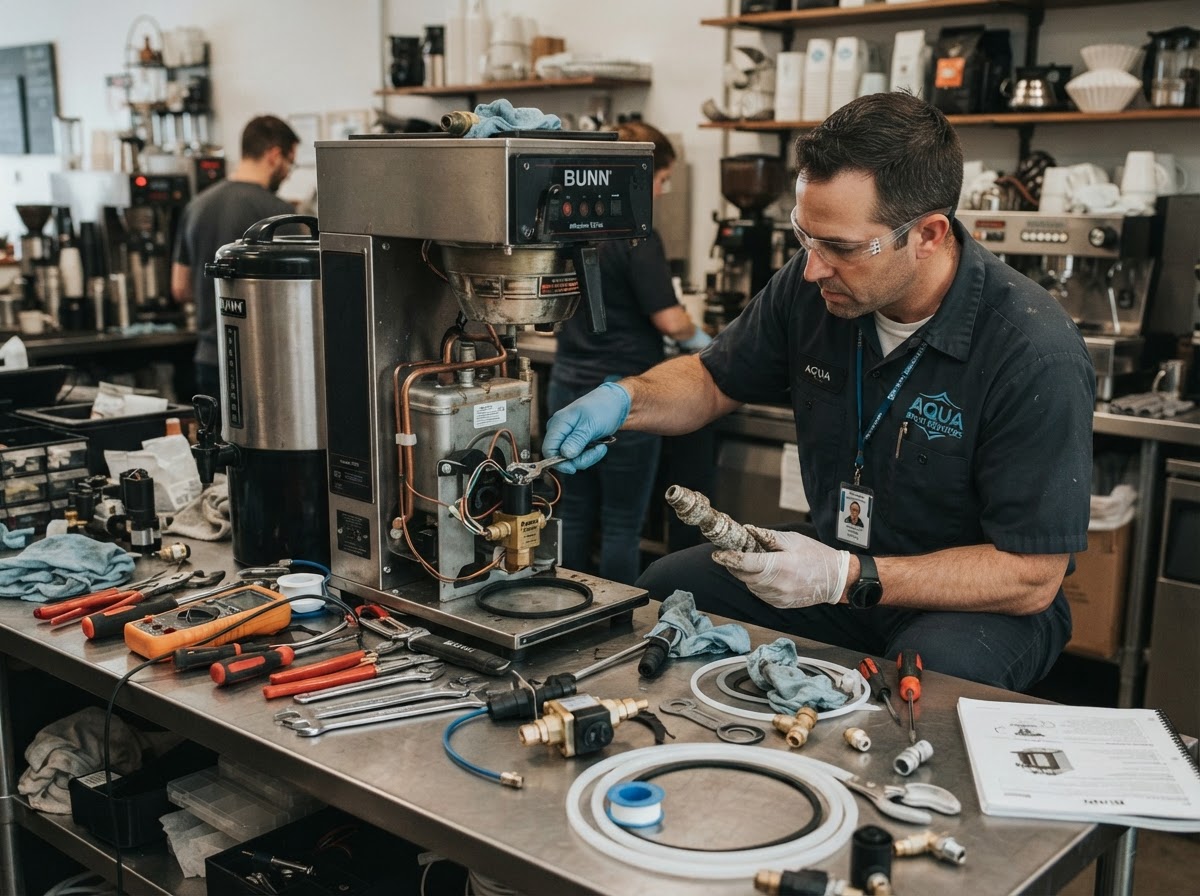
Solenoid Valve Inspection: The inlet solenoid valve controls water flow into the brewer. Mineral deposits and sediment can prevent the valve from fully closing, causing continuous slow water flow that overfills the brew tank or causes dripping from the sprayhead between cycles. If you hear water flowing when the machine is idle, the solenoid valve may need cleaning or replacement.
Shuttle Server and Urn Maintenance: Replacing sight glass seals and dispensing faucet washers stops continuous dripping and burnt coffee tastes. A dripping faucet wastes coffee and creates a mess; a leaking sight glass allows air ingress that can affect dispensing. Replace worn faucet washers and sight glass gaskets during quarterly service, and verify heating elements and thermostats on heated shuttles.
Decalcification: Even with good filtration, drip brewers accumulate scale in the hot water tank over time. Run a manufacturer-approved descaling cycle quarterly or more often in hard-water areas, and follow with multiple rinse cycles to ensure no descaling chemical remains. Deep-clean the brew funnel, decanters, and shuttles daily; coffee oils coat these surfaces and turn rancid, imparting bitter flavors to fresh batches.
Plumbing and Water Lines: For plumbed-in brewers, inspect the water supply line, shutoff valve, and regulator quarterly. A partially closed or sediment-blocked shutoff valve reduces flow rate, extending brew cycle time and potentially causing under-extraction. Verify incoming water pressure meets the manufacturer's specification, typically 20 to 80 psi. A qualified technician performing commercial coffee maker repair checks all of these systems to keep your batch brewer reliable.