
Commercial Coffee Machine Servicing: Scheduling, Scope, and Best Practices
Commercial coffee machine servicing is the disciplined practice of maintaining equipment on a schedule rather than reacting to failures. It combines daily cleaning performed by café staff with periodic professional service from a qualified technician. A well-structured servicing program protects your capital investment, preserves drink quality, and transforms unpredictable breakdowns into planned, budgeted service visits.
Determining Service Frequency: The right service frequency depends on your daily drink volume, water hardness, and operating hours. A high-volume shop pulling hundreds of shots daily may benefit from monthly visits, while a lower-volume office machine might need only semiannual service. Discuss your specific operating profile with your service provider to determine the cadence that balances cost and reliability for your operation.
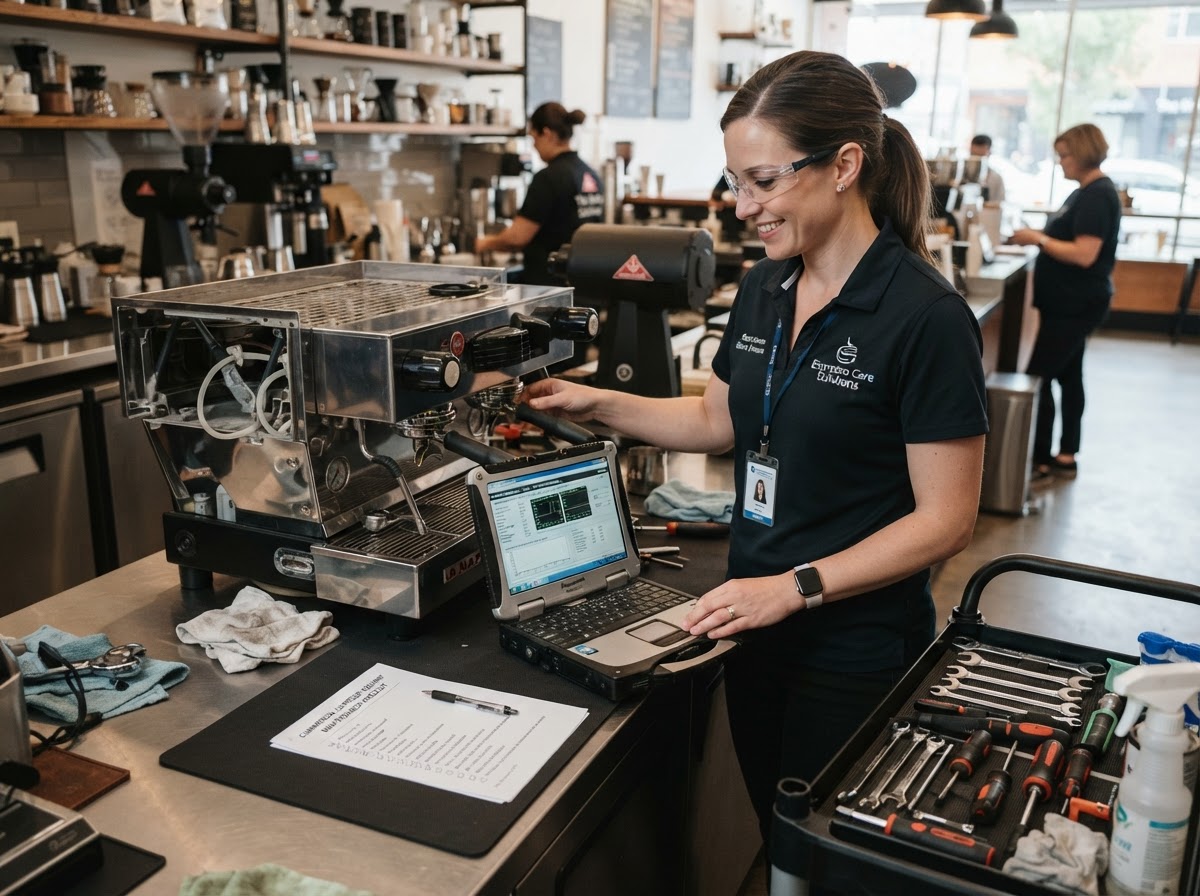
Scope of a Service Visit: A thorough visit includes replacement of group head gaskets, shower screens, anti-suction valves, and steam wand O-rings. The technician verifies brew and steam boiler temperatures, expansion valve pressure, and pump output pressure and flow rate. All electrical connections are inspected for heat damage, and the water filter pressure differential is tested. A complete visit takes one to three hours per machine.
Calibration for Consistency: Brew temperature consistency is critical for shot quality, and even a two-degree variation is perceptible in the cup. The expansion valve regulates brew pressure and should be set to the manufacturer's specification. Steam boiler pressure is usually set between 1.1 and 1.4 bar. These settings drift over time, so periodic verification keeps extraction dialed in across the full service day.
Parts Replacement Strategy: A good servicing plan includes proactive replacement of consumable parts on a schedule. Group gaskets, shower screens, and steam wand O-rings are replaced quarterly. Expansion valve and vacuum breaker seals are replaced annually. Pump rebuild kits and heating element gaskets may be replaced every two to three years. Your technician should provide a parts replacement forecast so you can budget in advance.
Water Treatment Integration: Water quality is inseparable from machine longevity. A qualified provider evaluates your water filtration as part of every visit and recommends replacement intervals based on your actual water chemistry and volume. Scale is the leading cause of heating element failure, and a servicing plan that ignores water treatment is incomplete. Track daily water volume and replace filters on a gallon-based schedule.
Documentation and ROI: After each visit, your technician should provide a written report listing parts replaced, measurements taken, and recommendations. Operators with proactive servicing contracts experience significantly fewer emergency calls over the lifespan of their machinery. Over a year, the plan typically costs less than two or three emergency calls, and the reduced downtime preserves customer goodwill. Comprehensive commercial coffee machine servicing is the most reliable way to keep your operation running through peak hours.